Live transmission for events: one feed in, every platform out
Send one RTMP stream from the venue. We restream it to the platforms you already publish on, hand your audience HLS / DASH links that play anywhere, and carry the same event inside your own mobile and Smart TV app, all from one uplink on the day.

What an event producer gets
- RTMP contribution from the encoder or switcher already at the venue
- Simulcast to YouTube, Facebook and any other account that takes an RTMP ingest
- HLS / DASH playback links for your own site, ticket page or delegate list
- The same event inside your own branded mobile and Smart TV app
- Recording held at the core site, so replay exists the moment the event ends
HOW THE EVENT LEAVES THE VENUE
You publish one stream from the venue: RTMP out of the encoder, the switcher or the software mixer your production already runs, pointed at the ingest endpoint we issue for the event. Where the connection at the venue is thin or lossy, contribute over SRT instead and the transport repairs itself rather than stalling in front of an audience.
That single feed lands at the core site nearest the venue, where it is normalised, transcoded into the ladder and packaged once. Everything downstream comes off that one ingest: the platforms, the playback links, the apps. The production uploads once, no matter how many destinations the event turns out to have.
Uplink at the venue is therefore sized for one contribution feed rather than for the audience: 8.4 Mbps nominal is comfortable on a business connection, and it does not grow when a second platform is added or when the tenth thousand viewer arrives, because the fan-out happens on our footprint rather than on yours.
While the transmission runs it is monitored the way a channel is: bitrate, frame rate and continuity per destination, alarmed to our NOC, with a shared channel to your production team on the day where you want one. A destination whose ingest fails is retried on its own and does not take the rest of the event down with it.
OUT TO THE PLATFORMS YOU ALREADY PUBLISH ON
Most events are already committed somewhere before the distribution question is asked: a YouTube channel that has the subscribers, a Facebook page that has the reach, an account a sponsor negotiated into the contract. We push your feed to each of them in parallel, with the stream key you give us per destination, so nobody at the venue runs three encoders and three uplinks to do it.
Destinations are configuration rather than plumbing. One can be added or dropped while the event is running, keys are held per event and not shared between them, and because each push is independent a platform that throttles, refuses or drops the connection is retried by itself without interrupting the others or the link your own audience is watching.
Where the rights are yours the simulcast is yours to decide, and where they are not we would rather build the restriction in than leave it to whoever is standing at the switcher. A territory sold exclusively, or a platform carved out for a sponsor, is recorded in the event configuration per destination before the transmission starts.
LINKS FOR YOUR AUDIENCE, AND YOUR OWN APP
Alongside the platforms, the same event is packaged as adaptive HLS / DASH: a manifest you can put behind a ticket page, embed in your own site, mail to a delegate list or hand to a partner broadcaster. It plays in a browser and in any standard player, and it is served from the delivery edge nearest each viewer rather than from the venue.
The ladder is four rungs from 1080p25 down to 360p, all at 25 fps, so a delegate on hotel wifi and one on fibre watch the same event at whatever quality their connection supports instead of watching a buffer. Access is yours to close: token, geography or MultiDRM per event where the transmission is not meant to be public.
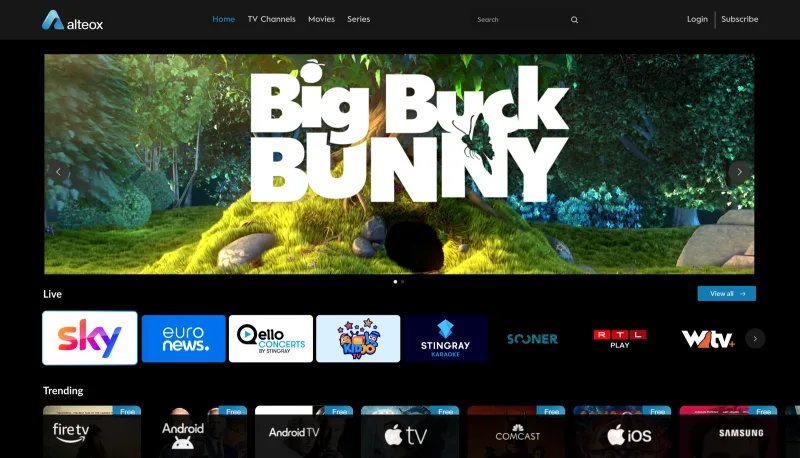
And where the event belongs inside a product rather than on a page, it can run in your own branded app on phones, tablets, Samsung Tizen, LG webOS, Android TV and Apple TV, as a live entry beside the rest of the line-up. The apps are a separate product with a page of their own, so judge them there rather than on a claim made here.
 WHITE-LABEL APPS
 GET IT ON AIR
Tell us the date, where the feed comes from and which destinations it has to reach. We issue the ingest endpoint and the playback links ahead of the event, and we would rather spend an hour on a rehearsal stream the day before than discover a firewall rule at the moment the doors open.
A recurring transmission, such as a league, a conference season, or a weekly service, is configured once and reused. The second event is a date in a calendar rather than a new build. Pricing follows that: per event where it is one, per month where it is a series, with no setup fee for the destinations you add.
If you would rather see the delivery chain before you trust an event to it, take the free three-day trial on channels already on the headend. It ships encrypted SRT and adaptive HLS / DASH together, which is the quickest way to judge picture, latency and packaging before a date is in the diary.
HOW IT IS PRICED
| SRT DELIVERYEncrypted MPEG-TS over the public internet | EUR 150 |
| HLS / DASH ADAPTIVEABR ladder + LL-HLS/DASH, packaged and CDN-delivered | EUR 200 |
| MultiDRMWidevine + PlayReady + FairPlay | + EUR 19 |
| Cloud DVR & replay7-day catch-up window | + EUR 29 |
| Restart & start-overJump to the start of the running show | + EUR 15 |
| EPG & metadata feedXMLTV + JSON, 14 days ahead | + EUR 9 |
Per channel, per month, excluding VAT. Volume discounts apply automatically from ten channels (up to 20%), a 12-month term saves a further 10% and a 24-month term 15%. Both are applied in the order total. 6 core sites, dual origin per channel.
LOOKING GLASS
Which of our points serves you fastest?
| Point of presence | Role | Distance | RTT | Jitter | Loss |
|---|---|---|---|---|---|
| LondonUK | edge | 0 km | 4 ms | 0.4 ms | 0.00 % |
| LilleFR | edge | 243 km | 7 ms | 0.7 ms | 0.00 % |
| ManchesterUK | edge | 261 km | 7 ms | 0.4 ms | 0.00 % |
| AmsterdamNL | edge | 358 km | 8 ms | 0.3 ms | 0.00 % |
Estimated from great-circle distance and our routing table. Ask the NOC for a live probe from your own prefix before you sign.
Questions we get from Live events
What do we send from the venue?
RTMP from the encoder, the production switcher or the software mixer you already use, pointed at the ingest endpoint we issue for the event with a key of its own. Where the venue link loses packets, contribute over SRT instead: it repairs the losses inside a latency window set from the measured round trip rather than stalling the transmission.
Can you push to our own YouTube and Facebook accounts?
Yes. You give us the stream key per destination and we push to all of them in parallel from our side, so the venue uploads once instead of running an encoder per platform. Anything that accepts an RTMP ingest can be a destination, and a platform that refuses or drops the connection is retried on its own without touching the others.
How does our own audience watch it?
On an adaptive HLS / DASH link issued per event, which plays in a browser and in any standard player and is served from the delivery edge nearest each viewer. Put it behind a ticket page, embed it in your own site, or restrict it by token, by territory or with MultiDRM at EUR 19 per channel per month where the event is not meant to be public.
Can the event appear in our own app?
Yes, where you have one with us. The white-label apps carry a live event as an entry beside whatever else they show, on phones, tablets, Samsung Tizen, LG webOS, Android TV and Apple TV, under your brand and against the same access rules. The apps are a product of their own, so their page is the honest place to judge them.
Is the event recorded?
Recording runs at the core site while the transmission is live, so a replay link and an on-demand copy exist as soon as the event ends rather than after a file is uploaded from the venue. For a channel that runs continuously, cloud DVR at EUR 29 and restart at EUR 15 per channel per month do the same job permanently.
What does a live event cost?
It is quoted per event, or per month for a series, against the destinations you want, the length of the transmission and the audience you expect. There is no setup fee per destination, and a recurring series is configured once and priced as a series rather than as a sequence of one-off builds.